


For Immediate Release
November 12, 2025
NEW RESOURCE: Embodying Justice in the Built Environment: Just and Equitable Land Use Transitions
Some of the world’s most climate-ambitious cities – members of the Carbon Neutral Cities Alliance (CNCA) – have joined forces to reduce embodied carbon in the built environment, which is the CO2 footprint across the entire lifecycle of a building – from the production of building materials to their transportation, assemblage, and treatment after demolition. As leading cities have developed and deployed these policies, they are bringing into focus their potential impacts on local communities and opportunities to address historic and structural inequity in the built environment.
Our carbon-intensive built environment has been shaped by systems of social, economic, and political injustice, which are directly reflected in the physical structure of our cities. These injustices are evident in the disproportionate access to safe, healthy, and affordable housing, proximity to services and good schools, access to desirable employment and living wages, exposure to toxins, and consistent displacement of long-term residents and businesses to make way for financialized assets.
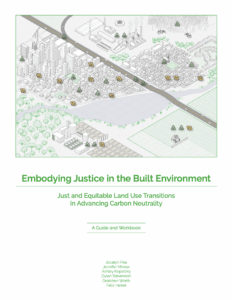
Embodying Justice in the Built Environment: Just and Equitable Land Use Transitions in Advancing Carbon Neutrality provides a framework for centering justice in land use planning for a carbon-neutral future. Practical examples from real-world scenarios, together with exploratory questions, guide the user through a process that centers meaningful community participation in considering social and economic impacts and opportunities rooted in an understanding of the local context.
| This guide and workbook are available for free download here
|
In Partnership With:
|
To learn more, a recording of the webinar held on Monday, November 24, 2025 is now available. This features a panel discussion with the project team and questions and insights from webinar participants. You can view the webinar here.
The resource was created by researchers in the Reparative Praxis Lab, Just Places Lab and Circular Construction Lab at Cornell University’s College of Architecture, Art, and Planning in partnership with the University of Washington College of Built Environments, Susan Christopherson Center for Community Planning, Circularity, Reuse, and Zero Waste Development (CR0WD) Network, and CNCA staff and officers from member cities provided input and feedback during its development.
This resource is part of a series:
- These guides build on the City Policy Framework for Dramatically Reducing Embodied Carbon
- The first guide focuses on applying justice principles to alternatives to demolition, resource management, and new construction: Embodying Justice in the Built Environment: Circularity in Practice
- This recent release is the second in a series: Embodying Justice in the Built Environment: Just and Equitable Land Use Transitions
“The design of our communities is rooted in historic and ongoing systems of injustice,” said Tracy Morgenstern, CNCA’s Climate Justice Director. “Planning and policy decisions, therefore, require participatory processes that prioritize communities who are the most impacted and have the greatest barriers to engaging in policy-making processes. This workbook provides a practical resource to help cities and community members to deepen their collaboration.”
Simone Mangili, CNCA’s Executive Director, emphasizes that as cities begin to consolidate pathways to rein in embodied emissions, it has become evident how decisions made in the land-use planning stages can lock such emissions in for the long term. Similarly, these decisions have the ability to determine long-term impacts on communities, allocating benefits and burdens within the very structures of our cities. Taking the time to carefully think through how embodied carbon policies can help reconfigure land uses to more equitably distribute the benefits and reduce the burdens is essential to ensure a just climate transition.
“Unintended harms from past planning practices continue to affect communities, but they are not irreversible. Meaningful change begins with listening and a willingness to understand place-based histories. This guide shows that justice-centered land use is not abstract nor unattainable in the pursuit of achieving carbon neutrality. Cities can take practical steps now by building stronger relationships, elevating community voices, and designing transitions that support shared futures.”
– Dylan Stevenson, University of Washington.
CNCA continues to partner with field leaders to develop resources for reducing embodied carbon in the built environment.
Learn more about:
- CNCA’s Climate Justice and Built Environment programs
- Cornell’s Reparative Praxis Lab, Just Places Lab,and Circular Construction Lab
- The Susan Christopherson Center for Community Planning.
- CR0WD (Circularity, Reuse, Zero Waste Development), a collaborative network from around New York State
- The University of Washington’s College of Built Environments
About Carbon Neutral Cities Alliance:
The Carbon Neutral Cities Alliance is a collaboration of leading global cities achieving carbon neutrality in the next 10-15 years — the most aggressive GHG reduction targets undertaken anywhere by any city. While it is possible for cities to achieve their interim carbon reduction targets through incremental improvements to existing systems, achieving carbon neutrality requires radical, transformative changes to core city systems. CNCA’s mission is to mobilize transformative climate action in cities in order to achieve prosperity, social equity, resilience, and better quality of life for all on a thriving planet.
Media Contact:
Simone Mangili, CNCA Executive Director
simonemangili@carbonneutralcities.org
Program Contact:
Tracy Morgenstern, CNCA Director of Climate Justice
tracymorgenstern@carbonneutralcities.org
###